
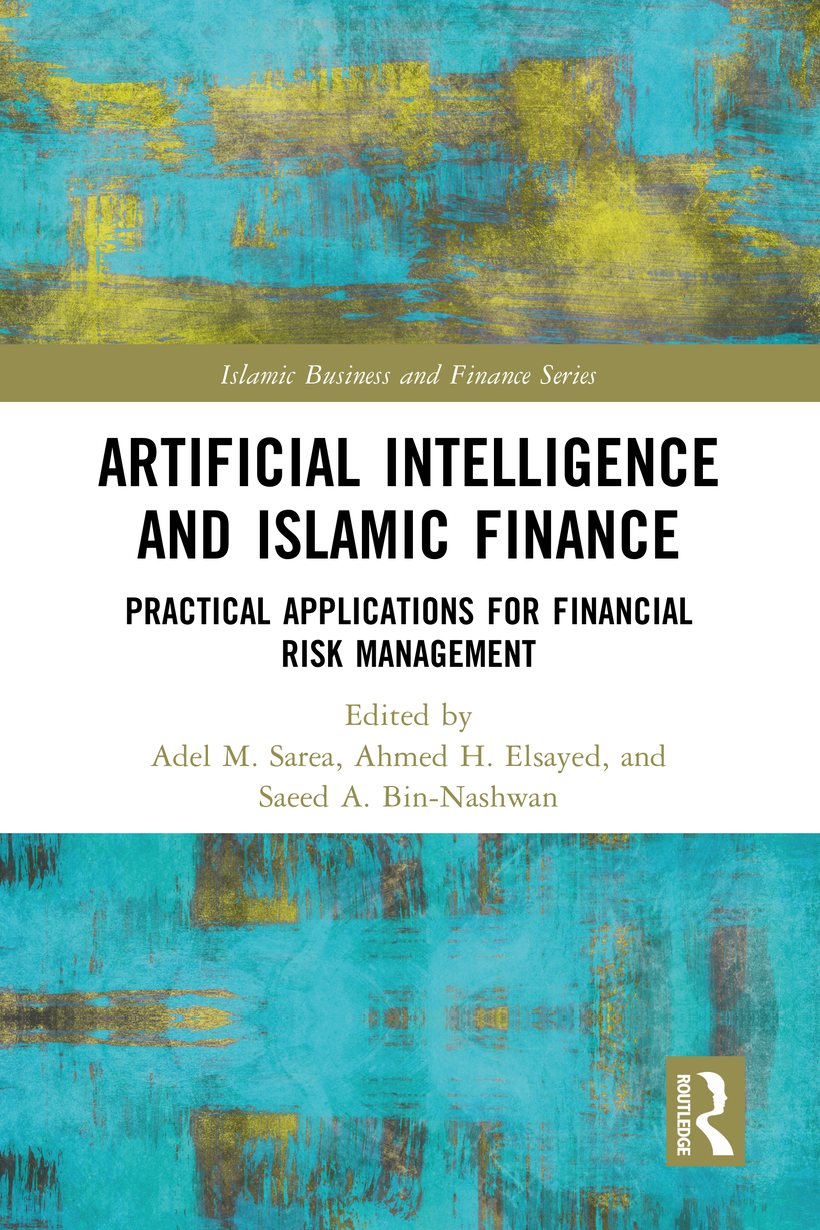
Artificial Intelligence and Islamic Finance: Practical Applications for Financial Risk Management, edited by Adel M. Sarea, Ahmed H. Elsayed and Saeed A. Bin-Nashwan, was published by Routledge in 2022 as part of the Islamic Business and Finance Series. Fifteen chapters, three parts, contributors drawn largely from Malaysia, Bahrain, the UAE, Indonesia and the UK.
The subtitle promises practical applications. That word carries a specific meaning in a delivery organisation, and it is worth being precise about whether the volume earns it.
My assessment is that it does not, and that this is the most useful thing about the book. What the editors have assembled is not a catalogue of deployed systems. It is a high-fidelity map of institutional intent across the Islamic finance industry as of 2021 and 2022. Read that way, with the ambition claims discounted and the constraint statements taken seriously, it is a genuinely valuable document. Read as an implementation guide, it will mislead you.
Basis of this assessment
I am working from the front matter, the editors' introduction (Chapter 1), and the consolidated per-chapter reference lists. The introduction is unusually substantial: it summarises all fifteen chapters in enough methodological detail to classify each one by evidence type, name the datasets and sample sizes, and identify the case studies. Where I refer to a chapter's findings below, I am referring to the editors' account of them. I have not read the chapter bodies, and I flag that explicitly because the distinction matters for how much weight the reader should put on anything I say about a specific result.
What kind of evidence is actually in here
The first thing a partner does with a fifteen-chapter volume is stop reading it as fifteen chapters and start reading it as a portfolio of evidence types. The classification is unforgiving.
| Evidence type | Chapters | What it can support |
|---|---|---|
| Empirical study with a stated dataset and method | 3 (DEA, 13 waqf institutions, 2007 to 2013), 10 (bibliometric, 225 Scopus articles, 2009 to 2020) | Findings about the past |
| Named commercial case study | 11 (Finterra Global Plantation), 13 (Wahed Invest) | Existence proofs |
| Proposed conceptual model, untested | 4 (AI-based Islamic P2P), 14 (cash waqf adoption model), 15 (wakalah smart contract) | Hypotheses |
| Literature review, framework synthesis, position | 2, 5, 6, 7, 8, 9, 12 | Orientation |
Seven of fifteen chapters are orientation. Three propose models that have not been run against data. Two are case studies of specific firms. Two are empirical, and one of those two is a study of publication counts rather than of financial institutions.
That leaves precisely one chapter in the volume that measures the operational performance of Islamic financial institutions using a defensible quantitative method. It is Chapter 3, and it is the chapter that matters most.
The finding that should change how you sequence work
Dahlia Ibrahim, Haslindar Ibrahim and Tajul Ariffin Masron examine thirteen waqf institutions in Malaysia over 2007 to 2013 using two standard Data Envelopment Analysis specifications. One institution is fully efficient. Twelve are not. The decomposition is the part to underline: the inefficiency is overwhelmingly managerial, not scale.
In DEA terms, that is a separation of pure technical inefficiency from scale inefficiency, and the diagnosis lands on the former. In operating terms it means these institutions are not failing because they are the wrong size or because they lack throughput. They are failing because of how decisions get made and how processes are run at the size they already are.
The chapter's own recommendation is to shift from manual assessment to automation using AI in order to reduce time and human error. This does not follow from the finding, and the gap between the two is the central analytical problem of the whole volume.
Automation compresses the cost and latency of executing a decision process. It does not improve the process. If your measured deficit is managerial judgment and process design, automating the current process gives you the same decisions faster and cheaper, at higher volume, with less human review in the path. On a portfolio of thirteen institutions where twelve are managerially inefficient, that is not a neutral outcome. It industrialises the deficit.
The correct sequence is the reverse of the one implied. Fix the decision process first, instrument it so the quality of decisions is measurable, then automate the parts that are demonstrably right. An institution that cannot articulate why its current allocations are what they are is not ready to hand those allocations to a model, and the DEA result is a direct measurement of exactly that inability.
Shariah compliance is a constraint on the model, not a filter on its output
Chapter 4 proposes an AI-based Islamic peer-to-peer lending platform with instant credit scoring, on the argument that the addressable market is large and young. The editors cite a Muslim population approaching a quarter of the world and a global median age of 24. The design requirement is stated cleanly: the platform must not involve riba, gharar, maisir or non-halal activity.
Those four prohibitions are not equivalent from an engineering standpoint, and treating them as a single compliance checklist is where implementations go wrong.
Riba and non-halal activity are, broadly, screenable. You can test an instrument, a counterparty or a sector against a rule set and get a determination. This is the part of Shariah compliance that maps onto a filter, and it is why most vendor compliance tooling stops there.
Gharar does not work that way. Excessive uncertainty in a contract is a property of the contract's structure and of the information asymmetry between the parties. It is not an attribute you can look up. A credit scoring engine that prices a facility off features neither party can inspect, using a model neither party can interrogate, is a plausible source of gharar rather than a neutral instrument that happens to need a compliance check afterwards. The model is inside the contract, not outside it.
Maisir is similar. The distinction between commercial risk-taking and speculation turns on whether return accompanies genuine productive exposure. A system that optimises for a return surface it has learned from historical data, without a structural link to the underlying enterprise, sits uncomfortably close to that line by construction.
The practical consequence is architectural. Shariah compliance for an AI-driven Islamic financial product has to be expressed in the feature space, the contract structure and the explainability requirement, not as a post-processing gate on the score. Any programme that scopes compliance as a filtering layer at the end of the pipeline has already made the design error and will discover it during Shariah board review, which is the most expensive place to discover it.
The most important sentence in the book gets the least space
Chapter 5, by Hazik Mohamed, covers the risk taxonomy properly: asset and liability management risk, credit, market, operational, liquidity, and regulatory and Shariah compliance risk. It extends into financial crime, monitoring of trader recklessness, anti-fraud and anti-money laundering. It is the most operationally literate chapter in the volume by the editors' account, and it includes an adoption risk table built on the Technology, Organization, Environment framework.
It also contains the observation that using AI itself adds another dimension of risk to the financial risk management framework.
That is correct and it is load-bearing, and it appears in one chapter of fifteen. Every other chapter treats AI as a net reduction in risk. The asymmetry is telling. A model in production is a new source of operational risk, model risk, concentration risk and, in this domain, Shariah risk. Institutions that adopt AI to manage risk without expanding the risk framework to cover the AI have not reduced their exposure. They have moved it somewhere they are not measuring.
Chapter 5 also identifies the real adoption constraints as acceptance, competency and readiness. That is the correct list, in roughly the correct order, and it is not a technology list. It is consistent with the Chapter 3 result.
Where the volume is weakest
Bibliometric growth is presented as industry maturity. Chapter 10 reviews 225 Scopus articles from 2009 to 2020 and reports rising annual production and citation counts. This is a measurement of academic publishing activity. It is a leading indicator of research interest and it tells you nothing about deployment, capital committed, or systems running in production. Reading a publication curve as an adoption curve is a category error, and the volume does not guard against it.
Only two named commercial cases across fifteen chapters. Finterra, in the blockchain waqf chapter, and Wahed Invest, in the robo-advisory chapter. For a book subtitled "Practical Applications", two named implementations is thin. It is also honest, and it accurately reflects the state of the industry at the time of writing.
Cost claims are unsourced. Chapter 8 is reported as asserting that millions of dollars can be saved by adopting AI in the finance sector. No baseline, no institution size, no cost line identified. A claim of that shape is unusable for a business case and should not survive editorial review in a volume aimed at practitioners.
The rhetoric occasionally overruns the evidence. Chapter 6 concludes that AI will in the near future become the nerve centre of Islamic finance. That conclusion is not supported by anything in the preceding chapters, and it sits three chapters away from a DEA study establishing that most of the institutions in question cannot currently run themselves efficiently by hand.
Reading the volume in 2026
The book went to press in 2022. Its conception of artificial intelligence is pre-transformer in practice: machine learning classifiers, credit scoring engines, robotic process automation, bibliometric text mining. Large language models are absent, and the specific capability that has changed the shape of this problem since publication, namely the ability to process unstructured contract language and Shariah pronouncements at scale, is not contemplated anywhere in the volume.
That capability shift matters more for Islamic finance than for conventional finance, and for a structural reason. A material share of the compliance burden in Islamic finance sits in unstructured text: contract wording, fatwa, resolutions of Shariah supervisory boards, AAOIFI standards, and the divergence between jurisdictions and between boards within a jurisdiction. Conventional finance codified far more of its equivalent burden into structured rules decades ago. The gap the book documents, between the ambition to automate and the ability to do so, is precisely the gap that language models narrow.
So the volume's central weakness is also the reason to read it now. It is a clean, dated snapshot of an industry articulating what it wanted to automate at the exact moment before the tooling to do so arrived. The wish list holds up. The technology assumptions do not.
What I would take into a delivery plan
Four things survive the audit.
One. Diagnose before automating. The single quantitative result in the volume says the constraint is managerial. Instrument the decision process, establish what good looks like, and only then decide what to automate. Automating an unmeasured process converts a management problem into a systems problem and makes it harder to see.
Two. Put Shariah compliance in the architecture. Feature space, contract structure, explainability. Not a filter at the end. Gharar in particular is structural and cannot be screened for after the fact.
Three. Expand the risk framework before the model ships. Chapter 5 is right. Model risk, and Shariah risk arising from model behaviour, belong in the framework at design time, not after the first incident.
Four. Treat governance as a technical requirement. Chapter 2 identifies three governance failure modes in FinTech firms against OECD guidance: extended executive director tenure, family shareholding, and founders sitting as board members. In institutions with those characteristics, the constraint on an AI programme is not model quality. It is whether anyone with independent standing can stop a model that is behaving badly. That is an organisational design question and it should be settled before the first model reaches production, not after.
The book will not tell you how to build any of this. It will tell you, with more candour than it seems to intend, why the industry has not.
Artificial Intelligence and Islamic Finance: Practical Applications for Financial Risk Management. Edited by Adel M. Sarea, Ahmed H. Elsayed and Saeed A. Bin-Nashwan. Routledge, 2022. Islamic Business and Finance Series, series editor Ishaq Bhatti. ISBN 978-0-367-77485-1 (hardback), 978-0-367-77487-5 (paperback), 978-1-003-17163-8 (ebook). DOI 10.4324/9781003171638. Foreword by Prof. Dato' Dr. Mustafa Bin Mohd Hanefah.